What are you looking for?
Blue Light Therapy
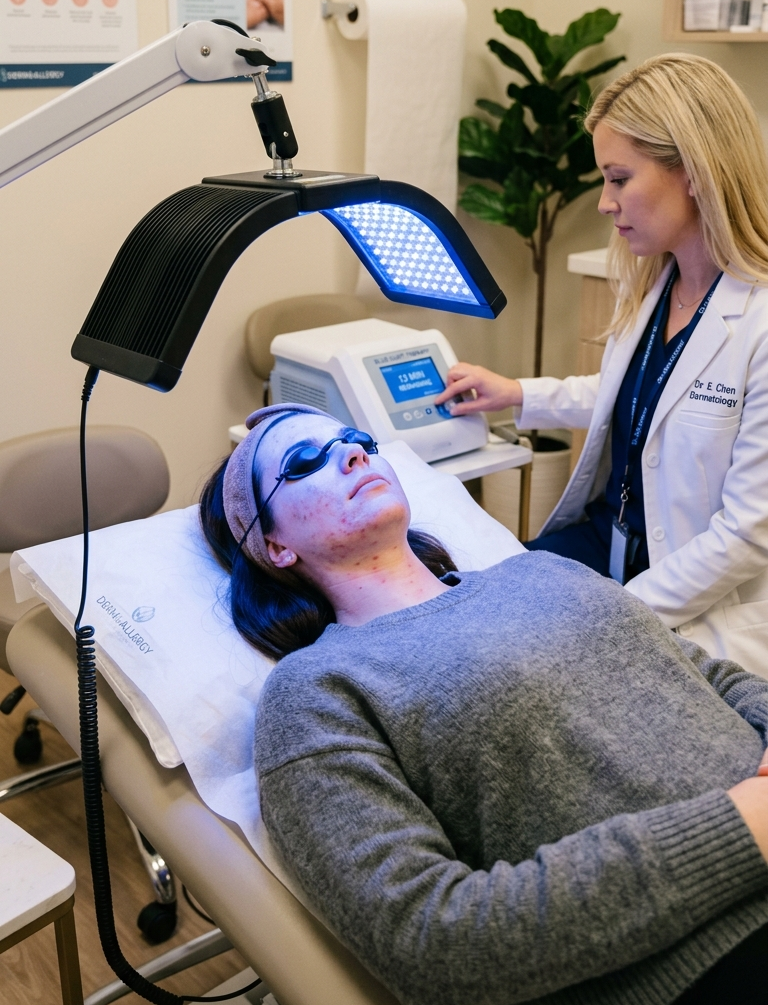
Blue Light Therapy is Photodynamic Therapy (PDT) that uses a blue laser to activate medication, selectively destroying abnormal cells. It’s used to treat actinic keratosis, skin cancer, rosacea, and stubborn acne, but it may also be used similarly to a chemical peel, to improve the texture and appearance of wrinkled and sun damaged skin.
In addition to smoothing skin and encouraging new, healthy cell growth, Blue Light Therapy removes precancerous cells. It improves fine lines and pore size and may significantly lessen some acne scars.
Who is it for?
Blue Light Therapy is safe for all skin tones and works well for many teens or adults who wish to drastically improve the appearance and texture of their skin. It is also a great option for anyone who wants to remove skin cells damaged by sun exposure. It’s safe for nearly all patients, including those with diabetes, and can be used to treat large areas, as an effective, noninvasive skin cancer prevention.
What is treatment like?
Your skin is cleansed and a special medicine is applied. Then you relax for about an hour while the medicine is absorbed. Your dermatologist will activate the medicine by shining blue lasers on the affected area, which generally takes less than 15 minutes. There may be a slight stinging or warming sensation, but the treatment is not painful.
There is no downtime, but you’ll need to stay out of the sun for 48 hours. After treatment, you may experience peeling, redness, swelling or a tingling sensation for up to a week. It may take multiple treatments to achieve your desired results.
What are the results?
After treatment, patients have a more evenly-toned complexion, a reduction in fine lines and wrinkles, and overall younger-looking skin.
Blue Light Therapy is also highly effective in reducing acne lesions, cysts, pimples, whiteheads, and blackheads, and in attaining a generally healthier complexion.
When used to treat actinic keratosis, Blue Light Therapy proactively destroys cells that might turn into skin cancer, preventing the need for surgeries and more invasive treatments down the line.
Patients in Daytona Beach, Clermont, Orlando, and Altamonte Springs can visit our clinics to discover how Blue Light Therapy may help support clearer, healthier-looking skin.
Physicians who perform this procedure:
Dermatology & Allergy for Blue Light Therapy
At Mid Florida Dermatology & Allergy, we bring clinical precision and personalized care to every blue light therapy session. Our board-certified physicians have extensive experience treating acne, actinic keratosis, rosacea, and sun-damaged skin using medical-grade photodynamic technology, and not the diluted, over-the-counter alternatives.
With multiple locations across Central Florida, including Altamonte Springs, Orlando, Daytona Beach, and Clermont, access to expert care has never been more convenient. We assess each patient individually to determine the right treatment plan, intensity, and number of sessions, ensuring you receive safe, effective results that go far beyond surface-level improvement.
Frequently Asked Questions
Most patients need two to four sessions of blue light therapy to achieve their desired outcome, though some improvements may appear after just one treatment, depending on the condition being addressed and its severity.
Coverage for PDT varies by insurance plan and medical indication. When used to address precancerous lesions like actinic keratosis, partial reimbursement may apply. Contact your insurance provider directly to confirm eligibility before scheduling.
Blue light therapy treatment can be sequenced alongside other procedures, but our physicians will recommend appropriate timing and spacing to prevent sensitivity conflicts and ensure optimal skin healing and results.
The treatment is generally well-tolerated even by sensitive skin types. Our team will assess your skin beforehand, and intensity can be adjusted to minimize potential irritation while still achieving effective outcomes.
While most commonly performed on the face, the treatment can be applied to other areas, including the back and chest, making it a versatile option for patients dealing with body acne or widespread precancerous changes.
The photosensitizing medication typically keeps the skin reactive for up to 48 hours after application, which is why strict sun avoidance is critical during that window to prevent unintended reactions or burns.
The treatment effectively destroys existing actinic keratosis cells, but ongoing sun protection is essential. New precancerous cells can form with continued UV exposure, and periodic follow-up appointments are recommended.
Stick to gentle, fragrance-free moisturizers and a broad-spectrum SPF 30 or higher. Avoid retinoids, exfoliants, and active acne treatments for at least one week after treatment to allow skin to recover properly.
No. Clinical blue light therapy uses a medical-grade photosensitizing agent and precise wavelengths under physician supervision, making it significantly more effective and targeted than at-home LED devices, which lack the activating medication.
Yes, the treatment is appropriate for many teen patients with persistent or severe acne and is performed under physician supervision to confirm candidacy and ensure safety for younger individuals.
Preview the Potential New You Today
A 3D Vectra Imaging consultation allows you to preview a photo realistic new you. Available at The Mid Florida Institute of Plastic Surgery in Altamonte Springs. Consultation fee applies.
